Published on
Net zero will not be enough for the winter sports industry
The outdoor winter sports industry will not survive through the 21st century unless society goes beyond global net-zero into net-negative emissions to lower earth’s average temperatures. Businesses that depend on revenues generated by winter recreation have a financial imperative to invest in negative emissions technologies today, so that we’re equipped to lower global temperatures in the future.


Aidan Preston, Ph.D.
Senior Impact Manager
The outdoor winter sports industry is on the frontlines of climate change.
Thirteen percent of all current ski areas are projected to completely lose natural annual snow cover and twenty percent will experience a reduction of more than 50% by 2071–2100 relative to historic baselines. Even today, resorts are increasingly relying upon water- and energy-intensive artificial snowmaking operations to supplement diminishing snow cover on their slopes.
According to the Intergovernmental Panel on Climate Change, freezing level heights in mountain areas will continue to rise and snow cover will decline over most land regions in the 21st century. And the pace of warming is higher as a function of elevation in mountainous regions around the world, accelerating change in snowlines and snow/rain transition heights. The already vulnerable position where resorts and winter sports competition organizers find themselves will become more and more precarious as long as emissions persist. And society's optimistic goal is to achieve net-zero emissions by 2050, so the situation will continue to worsen before stabilizing.
The Winter Olympics are already experiencing the impacts of a warming climate.
In the last 50 years, the probability of unfair-unsafe conditions in locations that have previously hosted the Winter Olympics has increased. This trend will accelerate as global temperatures continue to rise. The number of locations on Earth that are capable of reliably hosting a Winter Olympics has diminished so significantly that the IOC is considering a model of permanent, rotating host cities.
And relying on (water- and energy-intensive) artificial snowmaking to compensate for decreased snowfall may not only be an illogical solution to a problem caused by carbon emissions, it may not even be possible. Snowmaking only works when conditions are below a wet-bulb temperature threshold. This threshold will also be increasingly out of reach in a warming climate.
Individual winters with above- and below-average snowfall come with the territory. Weather is inherently uncontrollable. But as average temperatures rise and days of annual snow cover decrease, so too will average days with satisfactory conditions to stage competitions. Winter Olympics hosts are selected 10 years ahead of time, there is no flexibility if conditions are untenable. Imagine how much the Olympic Committee would be panicking if snowfall in 2034 resembles this winter!
Achieving net-zero emissions will not reverse warming
The most common graphs and figures in climate and corporate sustainability are emissions curves. This comes as no surprise, because reducing emissions to limit warming is the goal of Paris Agreement-aligned countries and sustainability-minded companies. However, emissions curves do not match temperature curves. Lowering emissions will decrease and slow warming (vital!), but it will not lower temperatures.
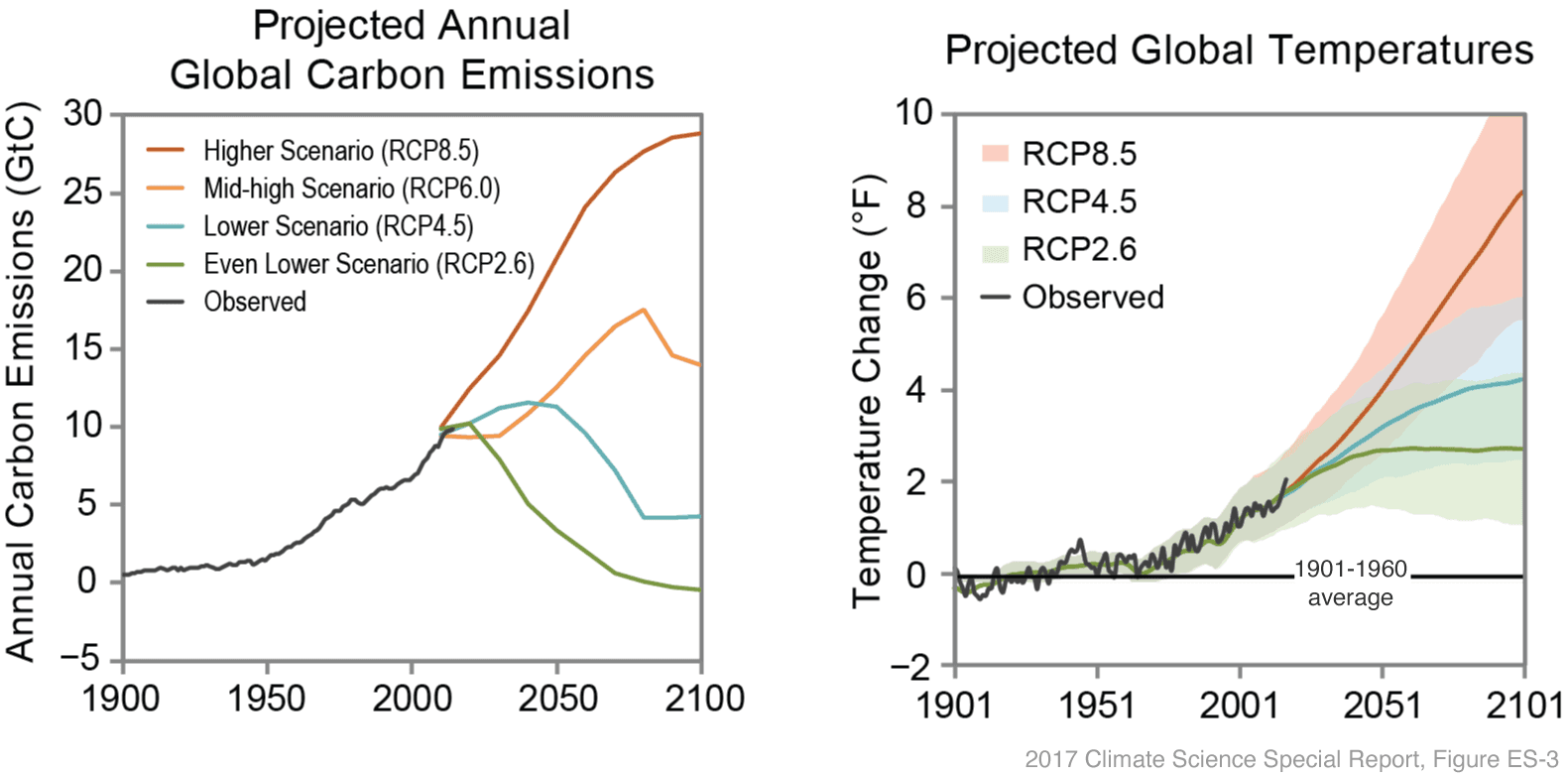
(left) Hypothetical pathways of carbon emissions ("representative concentration pathways," or RCPs) throughout the twenty-first century based on different possible energy policies and economic growth patterns. (right) Projected temperature increase relative to the 1901-1960 average depending on which RCP we eventually follow. Image by Katharine Hayhoe, from the 2017 Climate Science Special Report by the U.S. Global Change Research Program.
The green lines on the graph above show that if we achieve net zero emissions and stay there, then warming will cease, but the level of warming the planet has already reached is here to stay. This is bad news for the ski resorts! One study showed that 53% of ski resorts studied across 28 European countries are at very high risk for inadequate snow supply if global warming is limited to 2°C. This means that if we achieve a goal that is becoming increasingly aspirational, then most ski resorts will be at high risk of low snow supply.
The only way that average temperatures will return to a range that is not dire for the outdoor winter sports industry will be if the curve on the emissions graph (left) dips well below 0 and we begin to remove carbon from the atmosphere.
All winter sports stakeholders have a fiduciary responsibility to support the build out of durable negative emissions
They have limited direct control over global emissions, but members of the winter sports industry need to go above and beyond reducing their own emissions. They should also invest in carbon removal to provide much-needed support for an industry that is still in its infancy.
Organizations must also use their platforms to advocate for strong climate policies to reduce emissions as rapidly as possible. The more we limit warming, the less carbon we will have to remove to keep the winter sports industry alive.
Most industries will be negatively impacted by rising annual temperatures, but an industry that is centered around snow and ice is particularly vulnerable. The winter sports industry has already begun to show signs that it won’t survive if temperatures rise and remain elevated. Every stakeholder in the winter sports industry has an obligation to their shareholders to support the development of the carbon removal industry they will rely upon to survive.