Published on
From glaciers to groundwater: how AI is managing water security at scale
In the Himalayas and across Nigeria, it is being built directly into the infrastructure that stores, moves, and monitors water for climate-vulnerable communities. This article looks at two projects from Klarna's AI for Climate Resilience Program and what they are learning about putting AI to work inside physical water systems, including where its limits lie.
From advice to action
AI is already familiar as an advisor: a tool that turns complex information into guidance people can act on. Another role is quieter and more physical — built directly into the infrastructure that stores, moves, and monitors water for communities on the climate frontline. More than 2 billion people live under high water stress year-round, and around 4 billion face severe shortages for at least part of the year. These numbers are projected to rise as glaciers retreat, monsoons turn erratic, and groundwater is drawn down faster than it recharges.
How a community copes depends on the physical systems — hard to build and run where engineers are scarce, budgets thin, and conditions punishing. Two projects in Klarna's AI for Climate Resilience Program show what AI can do here: Acres of Ice in the Himalayas and Geotek in Nigeria.
Acres of Ice: timing water that arrives too late
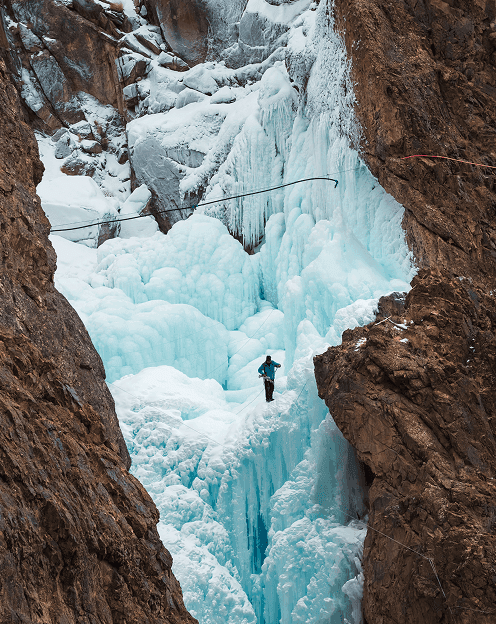
In Ladakh, in the high desert of northern India, farming depends on glacial meltwater that now arrives too late in spring, after planting. Acres of Ice stores winter water as towers of ice that melt through summer, releasing it when crops need it. Getting that right means controlling water flow against temperature and elevation, day and night for weeks, across sites scattered through remote mountain terrain — far more than any team could manage by hand.
Here the AI acts: sensors track each site, and a system running locally on cheap hardware decides moment to moment how much water to release, learning each microclimate as it goes. People set the limits: maximum flow, safety thresholds, seasonal targets. The system handles the rest.
Geotek: making an invisible resource visible
Across much of Nigeria, communities depend on boreholes that pump groundwater they cannot see. A stopped well looks the same whether the pump has failed or the groundwater is running low — you can't tell without measuring below ground. And more extreme, less predictable weather is also making these problems harder to see coming.
Geotek's sensors read the groundwater through how the water behaves, building a continuous picture of how much remains and whether current use is sustainable — work that once took occasional, expensive surveys. It draws on many complex data sources to assess the risk, but it doesn't pull any levers. What to do with the picture stays with communities and local authorities; the system gives them evidence to decide on, not decisions.
What it takes to work
What both projects show is that the technology alone isn't enough. Acres of Ice and Geotek work not because the models are clever, but because of everything built around them: local technicians trained to read the data, dashboards that make it usable for a farmer or a council, and data made accessible to the authorities and non-profits who act on it. Reliable infrastructure is not the same as useful infrastructure.
The harder work is rarely technical. It is securing support, making formal agreements at a community and government level, and finding partners on the ground who can install the sensors, understand the place, and absorb the failures of early deployments. These systems also have to survive conditions that would defeat most technology — no reliable connectivity, intermittent power, hardware exposed to dust, ice, heat and theft — which is why they are built lean and local. That is what AI cannot supply: the trust and the partnerships that decide whether any of it lasts.
A more careful optimism
These systems are early and imperfect. They depend on funding, maintenance, local trust, and partners who keep showing up, and any of those can fail. The communities adopting them are taking on real risk, and deserve a clear view of what could go wrong as much as what could go right.
What is encouraging is more modest. AI cannot run water infrastructure on its own — but deployed carefully, it can extend the reach of a small local team into the physical systems water security depends on, while leaving the decisions that matter with the people who live with them.
—————
The AI for Climate Resilience Program is a global initiative by Klarna to accelerate the use of AI in tackling the local effects of climate change — identifying and supporting innovators developing practical AI solutions for communities most exposed to climate risks, turning pilot ideas into scalable tools for adaptation and resilience.
Learn more at milkywire.com/ai-for-climate-resilience-program